Global marine insurance premium income increased by 5.5% to USD 42.6 billion in 2025, but the headline growth masks continued soft market conditions across most major business lines, according to the International Union of Marine Insurance (IUMI).
Presenting its latest market analysis at the IUMI Annual Conference in Rotterdam (20-23 September), IUMI said the increase was heavily influenced by currency movements, particularly the depreciation of the US dollar, while increased insurance capacity and competitive pressures continued to weigh on the underlying market.
Europe accounted for 46.5% of global marine insurance premiums in 2025, followed by Asia/Pacific with 30.8%, Latin America with 10%, North America with 7.2%, the Middle East with 3.5% and Africa with 2.1%.
By business line, transport/cargo remained the largest segment, representing 57% of global premiums, followed by ocean hull at 24.7%, offshore energy at 11.1% and marine liability, excluding P&I business covered by the International Group of P&I Clubs, at 7.3%.
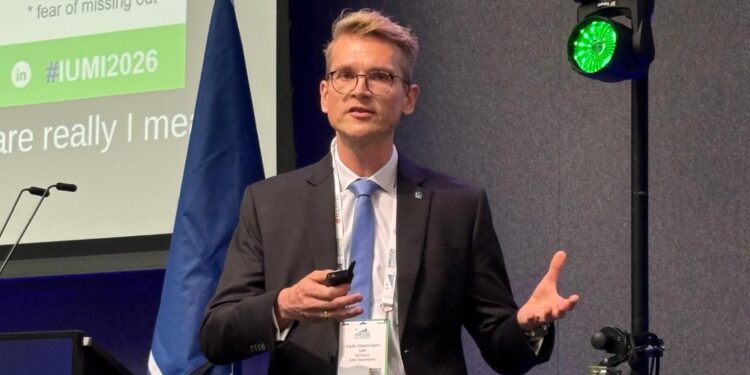
IUMI Chief Analyst Veith Huesmann said premium income is generally influenced by global trade volumes and commodity prices for cargo, vessel values for hull insurance, and oil prices and offshore activity for energy insurance.
However, he cautioned that the 2025 increase should not be interpreted as a strengthening of the underlying market.
The weakness of the US dollar has had a significant impact on the global figures, with major reporting currencies appreciating by around 7-13%
… Huesmann noted. Once currency effects are taken into account, he said, the market remains soft across the major business lines, with increased capacity adding to competitive pressure.
The claims environment remained relatively stable, with no catastrophic loss significantly affecting any major sector in 2025. However, attritional losses continued to accumulate and erode profitability, particularly in ocean hull.
Huesmann also noted that tariffs had not acted as the brake on global trade that some had expected, while stronger-than-anticipated global GDP growth supported marine insurance demand. He also pointed to the emergence of high-value semiconductor trade linked to the global artificial intelligence race, an exposure IUMI expects to become more visible in future statistics.
Asia continues to be the most significant growth area. IUMI said premium income in the region has increased steadily since 2016, with China increasingly driving the expansion, while European growth has continued but is being outpaced by Asia.
Cargo insurance
Cargo remained the largest marine insurance business line, with global premiums reaching USD 24.2 billion in 2025, up 6.9% from 2024.
The sector remains closely linked to global trade activity and movements in asset and commodity values. China was again a major source of growth, with premiums increasing by 19% during 2025.
IUMI attributed the increase partly to new products associated with the expansion of domestic e-commerce and return-insurance schemes, as well as high-value Chinese exports including electric vehicles, photovoltaic products and lithium batteries.
Asia now accounts for 36.4% of the global cargo insurance market, compared with Europe’s 37.6%. The gap between the two regions narrowed to just 3.3 percentage points in 2025, compared with 7.8 percentage points in 2024.
Loss ratios developed differently across regions. Europe’s cargo loss ratio fell to around 40%, while Latin America’s stood at approximately 45%. Asia’s was just below 70%, continuing an upward trend since 2020. In the US, the reported loss ratio fell from around 75% in 2024 to approximately 40% in 2025, although IUMI cautioned that this may partly reflect under-reporting.
The absence of major catastrophic losses, together with largely contained attritional losses, supported a stable claims environment. However, competitive pressure and continued capital inflows from managing general agents (MGAs) continued to soften the cargo market.
Ocean hull
Global ocean hull premiums reached USD 10.5 billion in 2025, an increase of 9.4% year-on-year.
Europe remained the dominant market, accounting for 51.3% of global hull premiums. China continued its strong growth trajectory, reflecting in part the increasing volume of Chinese-built newbuildings being insured domestically.
However, IUMI stressed that the increase in premiums needs to be viewed against continued fleet expansion. Global fleet growth is outpacing growth in the ocean hull premium base, which does not point to a strengthening underlying market.
Loss ratios in Europe appear to be moving back towards more normal levels following the post-COVID period, with the 2025 estimate at around 60%. Asia reported a loss ratio of approximately 50%, while Latin America recorded a significant reduction. The US market also improved, with a reported loss ratio of around 50%.
The global merchant fleet is expected to grow by approximately 3% by the end of 2026, although fleet growth has slowed compared with previous years. At the same time, the ageing fleet is creating additional challenges for insurers.
The average vessel age has now reached 22.4 years, with rising maintenance and repair costs and reduced availability of spare parts adding to the risk environment.
Geopolitical developments are also affecting hull insurance. IUMI noted that some markets combine war premiums with bluewater hull reporting, making it difficult to separate the two. The increase in attacks and associated war risks in the Red Sea contributed to premium developments in 2025, with the impact expected to become more significant in 2026.
After accounting for currency movements, fleet growth and war-risk effects, IUMI said the underlying hull market remains relatively soft.
Offshore energy remains in prolonged soft cycle
Global offshore energy premiums were broadly unchanged in 2025, reaching USD 4.82 billion, an increase of just 0.1%.
The UK remained the dominant market, accounting for 62.7% of global offshore energy premiums. IUMI also estimates that the UK represents around 30% of the global renewables insurance market, although the share of renewables is expected to increase in the coming years.
Offshore energy has now been in a prolonged soft market cycle for around six to seven years. The absence of major losses contributed to low loss ratios at the beginning of 2025, although IUMI expects claims to develop as losses mature.
The sector is nevertheless entering a significant investment cycle, driven by energy security concerns, geopolitical tensions and the transition towards lower-carbon energy sources. These developments are increasing both the value and complexity of risks being transferred to insurers.
Inflation, rising claims costs, excess capacity and competitive pricing continue to put pressure on profitability.
Geopolitics and capacity remain key challenges
Jun Lin, Chair of IUMI’s Facts & Figures Committee, said geopolitical uncertainty continues to affect all marine insurance business lines, while inflationary pressures and oil prices are adding to the challenges facing insurers.
The depreciation of the US dollar is another important factor, potentially masking underlying softening in the market while increasing claims costs where insurers pay claims in currencies other than the US dollar.
At the same time, IUMI said insurance and reinsurance capacity is at record levels, intensifying competition and putting further pressure on profitability.
There are also positive underlying factors. Seaborne trade continues to grow, the global merchant fleet is expanding, and capital expenditure in offshore oil and gas and renewable energy is increasing. Insured values and charter rates are also generally rising.
Nevertheless, IUMI’s overall assessment is that marine insurance remains a soft market despite the increase in headline premium income, with currency effects, excess capacity, competition, ageing tonnage, attritional claims and geopolitical risks continuing to shape the sector.
IUMI’s latest assessment is based on its annual global marine insurance market analysis, which covers the major cargo, hull, offshore energy and marine liability segments.
Source: Safety4sea
Robban Assafina is now on WhatsApp channel. Click Here